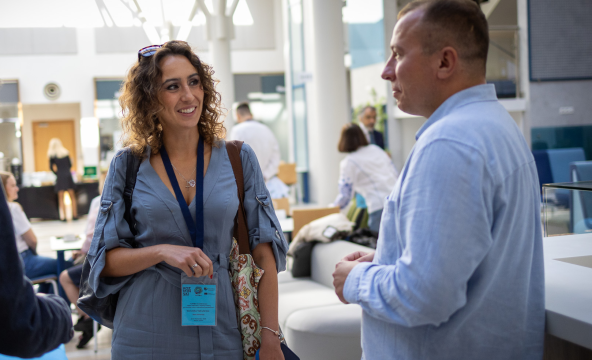


Powerful and personal speech: Rose Martin, Dean of the Faculty of Education and Arts, delivered this address during the celebration of Sámi National Day on February 6, 2026, at Nord University’s campus Røstad in Levanger. Photo: Bjørnar Leknes.
Each year, when I prepare a speech for Sámi National Day, the first thing I think of is my body in relation to this place.
I picture my feet on the ground here at Røstad campus - the soles of my feet on the earth, on South Sámi land, feeling the ground under my feet.
It is not my land. I am a guest, with my feet skimming the surface rather than planting roots.
But, I try to listen and I try to imagine.
I imagine the South Sámi ancestors of this land, the people of this land.
I ask myself:
What might their stories be?
What might they have endured?
What might they have loved, protected, built, carried?
And what about the generations of Sámi that followed, generation after generation, what have they experienced? What have they felt? What are their stories?
If the land could tell these stories, what would it say?
I think of the title of one of the well-known dance works made by Sámi choreographer Ella Sofe Sara called “the answer is land.”
Indeed.
The answer to these questions I pose, is, I believe in the land.
The answer is land.
And each year, as I prepare this speech, I also feel an unease.
It is the same unease I feel when I consider my own settler colonial history, knowing that four and five generations ago my own ancestors arrived in Aotearoa New Zealand from Poland, Germany, Ireland, and Denmark – as colonisers.
And until somewhere between my parents’ generation and my own, this was rarely discussed, rarely named, rarely dealt with as colonialism – especially by those of us who benefitted from it.
That unease I feel matters and should be named.
Not as a performance.
But as something to be acutely aware of that should give force to responsibility.
It makes me think carefully about the footsteps I take in relation to what I am part of, what I inherit, and what I must refuse to reproduce.
It makes me ask:
What is my responsibility to un-do harm—or, at the very least, to do differently to not blindly reproduce harm?
And how can I take different actions—even in small ways—that contribute to decolonisation as a living, ongoing practice?
Because we cannot speak about land, colonialism, or injustice to indigenous populations without speaking about power.
And we cannot speak about power without speaking about systems, structures, and institutions that uphold power – even unconsciously or even with the best of intentions sometimes.
We must recognise that most universities are colonial and imperial structures.
They were built to foster and organise knowledge, and that fostering and organization brings hierarchy: whose knowledge counts, whose language is most legitimate, whose worldview becomes most visible, whose histories are archived, funded, and celebrated.
So we must be honest: today is vitally important and necessary, absolutely, however celebration days are not enough.
Nord University holds responsibility—real responsibility—for the ways it relates to South and Lule Sámi communities, languages, knowledge, and land. Responsibility is not a statement. It is not a paragraph on a webpage. Responsibility is what we do, consistently, publicly, materially, and with humility.
I carry a vision in my mind: that the visibility and practice of Sámi communities, knowledge, languages, and culture are just as present in spaces and places for the other 364 days of the year as they are today.
Not as decoration. Not as tokenism.
But as a living presence—embedded in teaching, research, hiring, leadership, resourcing, relationships, and decision-making.
I realise we have a long way to go.
But we must try.
On a day like today, we must also acknowledge that the struggle for true and genuine liberation of Indigenous and oppressed peoples is entwined—from Sapmi to Palestine, Aotearoa New Zealand to Iran – and everything between and beyond.
These struggles are different, but they speak to each other.
These struggles do not remain confined within borders, they reach beyond – in migration, in government policy, in digital spaces, in universities.
These struggles teach us how power works, and they should teach us what solidarity demands.
And solidarity demands more than one day a year. It demands daily care and love.
As Bell Hooks tells us:
“We must love and care for each other as a radical act of resistance. The struggle for liberation is not simply an intellectual pursuit. It is physical, emotional, and spiritual. Hope grows when we come together as community—when we lean on each other in our shared struggle, and when we recognise that our collective joy is part of our resistance. In the face of oppression, love becomes a weapon—not a weapon that destroys, but a weapon that transcends fear, that heals, that brings us together”.
Today is a day of care.
Today is a day of love.
Today is a day of celebration.
Today is a day of acknowledgement.
Today is a day when Sámi voices should be amplified, for sure.
Today is a day for remembering and considering the stories of the past, experiences of the present, and for imaging of the future.
But I want to compel us to see something else, too:
Today must also be a day for deep reflection—within ourselves, within our systems and structures, within our thinking—and perhaps most significantly, within our actions.
Because reflection that doesn’t change anything is not reflection—it is privilege.
So the question is not only: what will we say today?
The question is: what will we do tomorrow?
And the next day.
And the next.
And next.
I deeply acknowledge the Sámi people on Sámi National day.
I give my absolute respect for the knowledge, languages and culture they carry.
I hope for a wonderful celebration today.
And, if the answer is land, then all of us who stand on this land, have responsibility to uplift, give space, look to, listen, value and stand with Sámi and all other indigenous populations, locally and globally, today, tomorrow, and everyday thereafter.